Why Vibe Coded Websites Fail to Rank
Vibe coded websites can look polished and still fail in search. Here is why weak structure, thin content and technical SEO gaps hold them back.

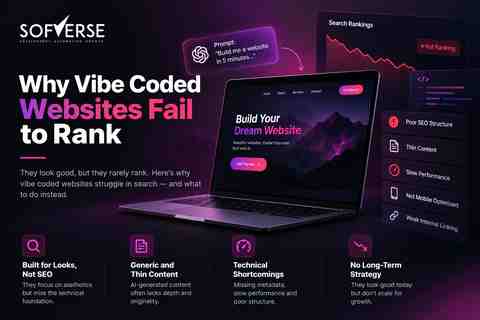
Vibe coding has made it dramatically easier to turn an idea into a working website. Give an AI builder a prompt, choose a visual direction, make a few edits, and a polished site can exist in hours instead of weeks. That speed is useful. The problem starts when the website is treated as finished simply because it looks finished.
Search engines do not rank screenshots. They evaluate pages, site architecture, crawlability, relevance, performance, internal relationships, authority and whether the content actually answers what people are searching for. A vibe coded website can look expensive while still giving Google very little reason to rank it.
Vibe coding optimizes for appearance first
Most AI website workflows begin with visual instructions: make it modern, use a dark theme, add animations, create a strong hero section, and make it feel premium. Those instructions naturally optimize the output for presentation. They do not automatically create a search strategy.
A strong site needs both. The visual layer matters for trust and conversion, but the underlying pages also need to be built around real search demand. That means deciding which services deserve dedicated pages, which topics support those services, how pages should link to each other, and which search intent each URL should satisfy.
That is why our web design work is tied directly to structure and usability rather than treating design as a separate layer from growth.
Generic AI content creates weak relevance
One of the biggest problems with vibe coded sites is generic copy. The homepage often says the business is innovative, reliable, customer focused and committed to quality. Service pages repeat the same language with a different heading. It sounds clean, but it does not build meaningful topical relevance.
Search engines need enough context to understand exactly what a business does, who it serves, how its services differ, and which queries each page should appear for. A five section site with shallow copy usually cannot compete with a site that has detailed service pages, supporting resources and strong internal linking.
For example, a development company should not force frontend development, backend systems, API development and custom tools into one generic page. Each service can target a different search need. Sofverse already separates those topics through its development services, frontend development and API development pages.
Technical SEO is usually an afterthought
A page can be beautiful and still have poor crawlability, duplicate metadata, weak heading hierarchy, oversized assets, missing schema, bad canonical rules or JavaScript that delays important content. These issues are not always visible to a visitor, which is exactly why they are easy to miss during a fast AI build.
Our guide to technical SEO foundations covers the basics in more detail, but the core principle is simple: Google must be able to discover, render, understand and index the important parts of the site efficiently.
Performance also matters. AI generated frontends frequently include unnecessary libraries, oversized effects and components that are visually impressive but expensive to load. If every page ships too much JavaScript, image weight and animation logic, the result can be a weaker mobile experience and poorer Core Web Vitals.
Vibe coded sites often have weak internal architecture
Search visibility compounds when pages support one another. A service page should receive links from relevant blog posts. Related services should connect naturally. Location pages should connect back to the service they represent. Supporting content should reinforce the commercial pages that matter most.
This is where many fast builds collapse into a flat collection of URLs. The navigation may work, but the site lacks a deliberate hierarchy. Google sees fewer contextual signals, and users have fewer paths into deeper pages.
A better approach is to connect content with intent. An article about why AI built websites struggle to rank should point readers toward relevant SEO strategy services, development resources and design pages. For businesses evaluating help in different markets, it should also make the geographical structure visible through the Sofverse service areas hub rather than leaving location relevance isolated.
Location relevance needs more than changing a city name
Location pages are another area where automated site generation can go wrong. Creating dozens of nearly identical pages and swapping the city name does not create strong local relevance. Useful location pages need unique context, a clear relationship to the service being offered, relevant internal links and enough differentiation to justify why the page exists.
The strongest structure connects a location to a real service. A visitor looking for web design in a particular market should be able to move naturally from the location page to the relevant web design, development or SEO service page. Likewise, service pages should make it easy to discover where the company works. That relationship helps users and gives search engines a clearer site graph.
Search intent is not something a visual prompt can guess reliably
Prompts such as “build me a website for a software agency” are too broad to define an SEO plan. They do not tell the model which keywords matter commercially, whether a query is informational or transactional, which page should rank for which topic, or what the competitive search results already reward.
Keyword selection should influence the architecture before the final page copy is written. If several pages accidentally target the same query, they can compete with each other. If no page targets a valuable query directly, the site may never become relevant enough to enter the results.
There is usually no long term content system
Ranking is rarely a one time website task. Sites grow by adding useful pages, earning links, updating old content, strengthening internal connections and responding to new search demand. A vibe coded launch can give a company the shell of a website, but without a content and SEO system the shell stays static.
That is why the correct question is not whether AI should be used to build websites. It should. AI can accelerate research, prototyping, development and production enormously. The real question is whether the website is being built from a search strategy or merely from a visual prompt.
How to use vibe coding without sacrificing rankings
The better workflow is to define the site architecture first, map search intent to specific URLs, establish technical standards, build the visual system, then use AI to accelerate implementation. After launch, measure indexing, rankings, performance and conversions rather than assuming the build is complete.
- Map one primary search intent to each important page.
- Create dedicated pages for commercially important services.
- Use location pages only where they provide genuinely useful local context.
- Build internal links between services, locations and supporting articles.
- Validate titles, descriptions, canonicals, schema and heading structure.
- Test mobile performance and Core Web Vitals before launch.
- Keep publishing content that strengthens the topics you want to own.
Vibe coding is not the problem. Building without strategy is. A fast AI generated site can rank perfectly well when the architecture, content, technical SEO and internal linking are engineered deliberately. Without those foundations, a website can look excellent and remain nearly invisible in search.
If you are planning a new build or trying to fix a site that looks good but does not generate organic traffic, start with the structure. Explore Sofverse’s SEO strategy, web design, development services and service areas to see how those pieces connect.

sofverse
The Sofverse team designs, builds and scales websites, web applications, automation and growth systems for businesses across the United States.
More articles